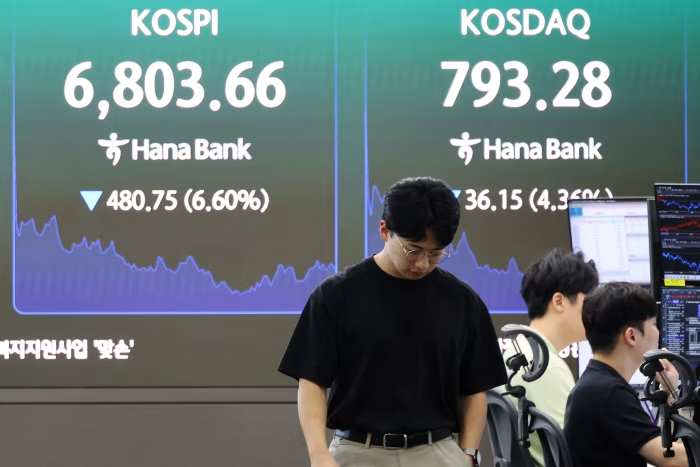
South Korean small investors ditch home stocks to buy $4.6B in US shares following a major crash in the local KOSPI index.
Small retail investors in South Korea, popularly called “ants” because of their massive numbers and collective trading power, have completely turned their backs on their local stock market, abandoning home shares to pour billions of dollars back into American Wall Street stocks. Data released by the Korea Securities Depository on Friday, August 7, 2026, revealed that individual traders bought four point six billion dollars worth of United States stocks in July. This sudden massive outflow marks the biggest rush of Korean money into American stock markets in six months.
This sudden capital shift happened in Seoul after South Korea’s benchmark KOSPI index suffered a severe price crash, recording its worst monthly loss since the peak of the 2008 global financial crisis. For the first time since February, retail stock purchases in international markets officially surpassed total buying in local South Korean shares. The sudden departure of these everyday traders proves how fast investor trust in local companies evaporated when tech stock values began dropping rapidly across Asian trading floors.
To understand why thousands of individual traders are rushing to send their savings overseas, look at how the local market failed to hold their interest. For several months, the South Korean government launched active incentive programs offering tax breaks to convince citizens to sell foreign stocks and reinvest their profits back into home companies. However, because major local tech giants like Samsung Electronics and SK Hynix faced intense price swings during recent global market corrections, local traders got tired of losing money on home turf. Everyday investors decided that placing their money into big American technology companies offers far better long-term security.
This massive movement of money carries severe economic risks for South Korea’s broader financial system. When millions of ordinary citizens swap local South Korean won for United States dollars to buy Wall Street stocks, it weakens the value of the national currency against the dollar. Financial analysts warn that if this flight of retail capital continues, the falling currency will make imports more expensive, frustrate government officials trying to grow domestic markets, and force local companies to work twice as hard to attract funding.
See Also: SK Hynix Promises Extra Cash for Shareholders After Massive AI Chip Boom
The sudden return to American stocks shows that government tax perks alone cannot keep retail investors around when local stock prices are falling. As global technology markets navigate heavy volatility, South Korea’s “ant” investors have made their voice clear: they would rather take their chances on Wall Street than watch their savings shrink at home.

About the Author
Jennifer Sakmufuwo Baba is a tech analyst, senior staff, and writer covering artificial intelligence, cybersecurity , and emerging technologies at TechRegard. Based in Nigeria, she's passionate about translating complex tech developments into compelling, accessible stories for diverse audiences. Her work focuses on how technology shapes innovation across Africa and globally.