

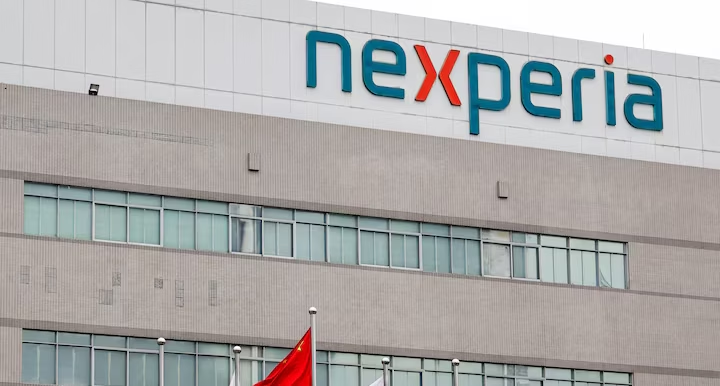
A Chinese court has frozen up to 2.14 billion yuan ($300 million) in assets held by Dutch chipmaker Nexperia and its equipment arm following a lawsuit filed by the company’s Chinese owner, Wingtech Technology.
The order adds another layer to the long-running dispute over control of Nexperia, which has strained relations between China and the Netherlands and raised concerns about supplies of semiconductor components used in automobiles and consumer electronics.
Wingtech said the Dongguan Intermediate People’s Court issued the asset-freezing order in connection with its lawsuit against Nexperia, its equipment arm, Nexperia’s parent company and three executives.
The case, filed in May, accuses the defendants of carrying out or assisting what Wingtech described as discriminatory restrictions imposed by Dutch authorities.
Wingtech is seeking 8 billion yuan in damages, although the case has not yet gone to trial.
The latest court action covers Nexperia’s stakes in four China-based businesses, including its semiconductor operations in China, Wuxi and Shanghai, as well as a wholly owned Wuxi unit belonging to its equipment arm.
The asset restrictions took effect between August 20 and August 25 and are scheduled to remain in place until August 2029, according to details disclosed by Wingtech.
The freeze does not change Nexperia’s current management structure or settle the broader dispute over ownership and control of the chipmaker, but it gives Wingtech additional leverage in its efforts to regain voting control.
The conflict dates back to last year when the Dutch government intervened in Nexperia, citing concerns that technology, funds and production assets could be transferred out of the Netherlands.
See also: Ndukwe Reveals What Nearly Stalled Nigeria’s GSM Revolution
A Dutch business court subsequently suspended Nexperia’s chief executive and placed the voting rights attached to Wingtech’s stake under independent management.
The intervention triggered a wider diplomatic dispute between Beijing and The Hague, with China later imposing export controls on Nexperia’s operations in the country.
The restrictions disrupted shipments of the company’s semiconductor products and heightened concerns among global manufacturers that rely on Nexperia components.
Following negotiations between China and the Netherlands, Beijing agreed to allow supplies to resume, while the Dutch government suspended its intervention order.
The agreement, however, did not restore the voting control Wingtech had lost, leaving the underlying ownership dispute unresolved.
Nexperia and its equipment arm had not immediately responded to requests for comment on the latest Chinese court order.
The dispute remains significant for the global semiconductor industry because Nexperia produces chips widely used in vehicles, consumer electronics and other products, making any prolonged disruption to its China operations a potential concern for manufacturers and suppliers.

About the Author
Cecilia Attah is a tech analyst with a degree from Benue State University. She covers tech news and startups at TechRegard with a focus on how technology is transforming Africa and shaping the global landscape.


