

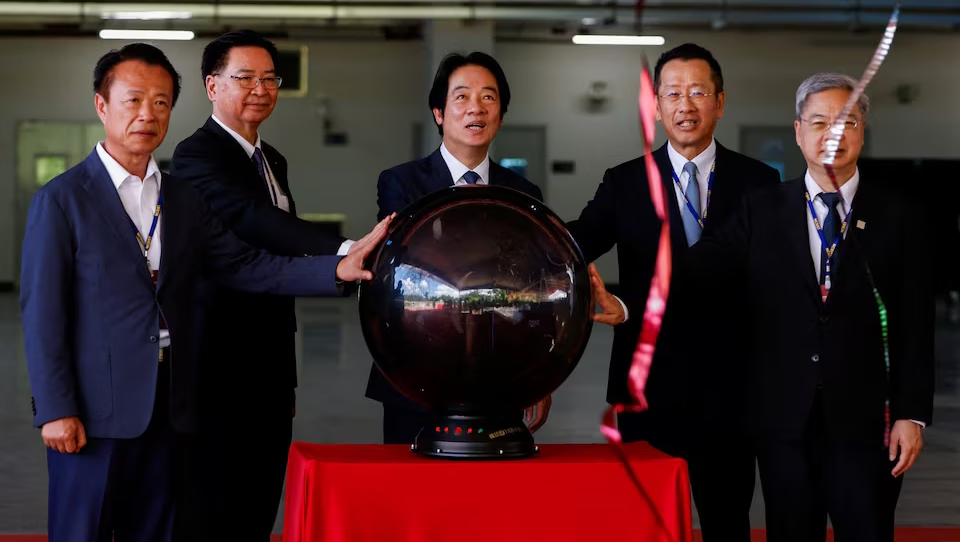
Taiwan has called for deeper cooperation with democratic partners to develop drone technology and build a more resilient unmanned aircraft supply chain as the island steps up efforts to modernise its defence capabilities.
President Lai Ching-te made the call on Monday at the groundbreaking ceremony for a new drone development centre in Chiayi County, southern Taiwan.
Lai said the rapid evolution of warfare, particularly the growing use of unmanned systems on battlefields, had made drone technology increasingly important to national defence.
“From the Ukrainian battlefield to Indo-Pacific regional security, unmanned systems have become important combat strength in modern defence,” Lai said.
He said Taiwan needed to work with democratic partners to strengthen its ability to develop and manufacture unmanned aircraft while building a supply chain that could withstand disruptions.
“At the same time, we must deepen cooperation with democratic partners and jointly build a safer and more resilient unmanned aircraft supply chain, providing solid support for Indo-Pacific regional peace and stability,” he added.
The new drone development centre is part of Taiwan’s broader push to expand its domestic unmanned systems industry and strengthen its ability to produce defence technologies locally.
Taiwan has significant capabilities in semiconductor manufacturing, information and communications technology and precision engineering, areas that could support the development of increasingly sophisticated drones and other unmanned systems.
The government has made defence modernisation a major policy priority amid increased military pressure from China, which claims Taiwan as part of its territory.
Taiwan, which has governed itself since 1949, rejects Beijing’s sovereignty claims and says its future should be decided by its people.
The focus on drones also reflects changes in the way modern conflicts are being fought. Unmanned aircraft have become increasingly important for surveillance, reconnaissance, targeting and attacks, with their use in the war in Ukraine highlighting their ability to provide relatively inexpensive and rapidly deployable battlefield capabilities.
Taiwan is seeking to apply lessons from those conflicts as it prepares for potential security challenges in the Indo-Pacific.
Earlier this month, Taiwan’s Cabinet proposed an additional T$145.7 billion ($4.59 billion) in defence spending for 2026. The proposed package includes funding for drones and anti-ballistic missile systems.
See also: Microsoft partnered with oil and gas giant Chevron to launch Project Kilby
The planned purchases include more than 600 coastal surveillance and reconnaissance drones, over 40,000 coastal attack drones and an initial batch of more than 100 small unmanned attack boats.
The scale of the planned procurement underlines Taiwan’s growing emphasis on unmanned systems as part of its wider defence strategy.
Beyond military applications, Taiwan’s effort is also aimed at developing a domestic industrial base capable of designing, producing and maintaining unmanned systems and their components.
Lai said cooperation with democratic partners would be important in building that industrial capacity and ensuring access to a reliable supply chain for drone technology.
The push comes as countries across the Indo-Pacific increasingly invest in drones and counter-drone systems, while Taiwan seeks to combine its existing strengths in electronics and advanced manufacturing with new defence technologies.
The government has said strengthening domestic production and supply-chain resilience will be important as Taiwan expands its defence capabilities and responds to changing security conditions in the region.

About the Author
Cecilia Attah is a tech analyst with a degree from Benue State University. She covers tech news and startups at TechRegard with a focus on how technology is transforming Africa and shaping the global landscape.


