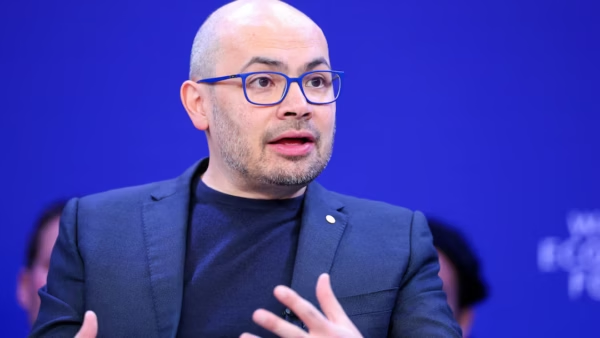
Sam Altman testifies in the Musk v. OpenAI trial, claiming Elon Musk wanted total control and mused about passing the AI firm to his children.
In a dramatic courtroom showdown that has laid bare the fractious history of Silicon Valley’s most valuable artificial intelligence enterprise, OpenAI CEO Sam Altman took the witness stand in an Oakland, California, federal court. The high-stakes appearance on May 12, 2026, provided a stark counter-narrative to the $134 billion civil lawsuit filed by billionaire Elon Musk, who accuses Altman and co-founder Greg Brockman of betraying OpenAI’s foundational, altruistic nonprofit mission.
A “Hair-Raising” Demand for Dynastic Control
During his testimony, Altman detailed the explosive governance disputes that fractured the co-founders’ relationship back in 2017. As the early research lab faced staggering computational costs, discussions arose about transitioning toward a capped-profit structure to attract vital capital.
According to Altman, Musk demanded absolute control over the proposed for-profit arm. The most stunning revelation came when Altman recalled asking Musk what would happen to that ultimate control in the event of his death. Musk allegedly mused that perhaps “control of OpenAI should pass to my children.”
Altman testified that the concept left him “extremely uncomfortable,” noting that the dynastic proposal directly violated the startup’s core ethos. “Part of the reason we started OpenAI is we didn’t think AGI [Artificial General Intelligence] could be under the control of any one person, no matter how good their intentions are,” Altman told the courtroom.
“Chainsaws” and Management Mind Games
Beyond the battle for structural dominance, Altman leveraged his time on the stand to criticize Musk’s erratic and “mercurial” management style. He claimed Musk severely damaged the company’s early culture by forcing leadership to implement strict “stack-ranking” exercises. Altman described Musk as wanting to take a “chainsaw” to lower-ranked researchers, a ruthless filtering approach reminiscent of his later takeovers of Twitter (now X) and government efficiency initiatives. According to Altman, this practice profoundly demotivated premier AI scientists at a critical developmental juncture.
Pushing back against Musk’s allegation that he effectively “stole a charity,” Altman defended the current $852 billion commercial giant, asserting that, through immense effort, OpenAI has created “one of the largest charities in the world” through its underlying nonprofit foundation. He sharply pivoted the blame back to the plaintiff: “Mr. Musk did try to kill it, I guess twice.”
A Combative Cross-Examination
The friendly questioning from OpenAI’s legal counsel quickly gave way to a blistering cross-examination by Musk’s attorney, Steven Molo. Molo immediately targeted Altman’s character, opening with the pointed question: “Are you completely trustworthy?”
While Altman maintained that he believes himself to be a “truthful person,” Musk’s legal team sought to establish a narrative of calculated deception. Molo read out a litany of prior statements from former OpenAI insiders to illustrate what they allege is a historical “pattern of behavior” involving a lack of candor.
This line of questioning mirrors a series of recent court depositions from former OpenAI executives, as highlighted in comprehensive coverage by The Guardian. Key figures like former Chief Technical Officer Mira Murati and former board member Helen Toner have testified under oath regarding Altman’s alleged habit of pitting executives against one another. Furthermore, co-founder Ilya Sutskever’s 2023 memo was brought to light, which explicitly accused Altman of a “consistent pattern of lying.”
The Trial’s Broader Stakes
As the trial nears its conclusion, the proceedings have evolved into a referendum on the integrity of both tech titans. While Altman faces intense scrutiny over his transparency and ambition, Musk’s own legacy faces exposure. According to Associated Press reports, the trial has aired embarrassing details regarding Musk’s personal life and corporate tantrums, balancing the reputational damage on both sides of the aisle.
With billions of dollars and the future governance framework of industry-defining AI tech hanging in the balance, the trial underscores a fundamental, unresolved question: Who can be trusted to hold the keys to humanity’s technological future?

About the Author
Jennifer Sakmufuwo Baba is a tech analyst, senior staff, and writer covering artificial intelligence, cybersecurity , and emerging technologies at TechRegard. Based in Nigeria, she's passionate about translating complex tech developments into compelling, accessible stories for diverse audiences. Her work focuses on how technology shapes innovation across Africa and globally.