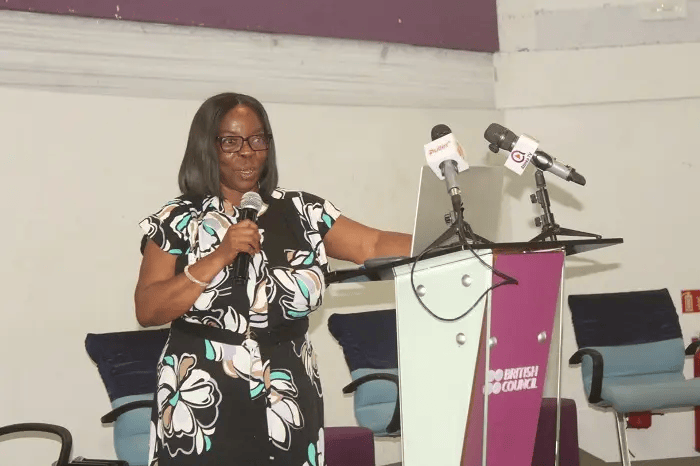
The Network for Women’s Rights in Ghana (NETRIGHT) led by Head of Secretariat Patricia B. Akakpo has submitted a comprehensive set of policy proposals to the Ministry of Finance for the 2027–2030 Budget Statement and Economic Policy.
The Network for Women’s Rights in Ghana (NETRIGHT) has called on the Ministry of Finance to ensure the upcoming 2027–2030 Budget Statement and Economic Policy incorporates gender-responsive planning.
Speaking at a public forum in Accra, NETRIGHT Head of Secretariat Ms. Patricia B. Akakpo emphasized that national economic planning must protect vulnerable groups including women, children, persons with disabilities, and low-income households from carrying an unfair burden during revenue collection and economic reforms.
The gathering forms part of NETRIGHT’s project titled “Influencing for Change: Integrating Women’s Voice in Inclusive Development.” The initiative is being implemented under the Renewed Women’s Voice and Leadership (RWVL) framework in partnership with Plan International Ghana, with financial support from Global Affairs Canada.
Ms. Akakpo stressed that national fiscal policy must move past broad commitments by introducing measurable gender-sensitive targets, concrete performance indicators and public tracking mechanisms.
According to Ms. Akakpo, these reporting frameworks are necessary so citizens can verify whether state allocations reach intended beneficiaries equitably across key economic sectors.
She noted that tax compliance must be matched by government accountability, requiring clear reporting on how public revenues fund essential social services and investments designed to reduce inequality nationwide.
Addressing national tax policy, Ms. Akakpo advocated for progressive and inclusive reforms. She called for stronger taxation of non-resident entities earning income within Ghana, stricter tax exemption rules and thorough benefit assessments to guarantee that tax incentives deliver clear public value.
Additionally, Ms. Akakpo urged the government to review customs, trade and investment policies through a gender lens. She noted that structural reviews are essential to ensure women can fully participate in export opportunities, secure business financing and access productive inputs, land, technology and commercial markets particularly within non-traditional value chains.
See also: Polaris Bank Mourns Branch Manager Killed in Imo Campus Attack
A major focus of Ms. Akakpo’s presentation addressed unpaid care work such as childcare, eldercare and domestic labor which acts as a structural barrier limiting women’s educational, professional and economic opportunities. She urged the government to treat care work as essential economic infrastructure and proposed a funded national care policy with cross-sector oversight.
Ms. Akakpo also advocated for increased spending on professional care services, integrating care support into social cash transfers to compensate family caregivers and establishing official training and certification to turn care work into decent, regulated employment.
In agriculture, Ms. Akakpo highlighted persistent systemic barriers that reduce women farmers’ productivity and income. She called for gender-responsive financing, land rights, processing tools and targeted irrigation support. To track progress, she urged the government to publish disaggregated data showing how resources like fertilizer, land, and technology are distributed among women, youth and persons with disabilities.
Finally, Ms. Akakpo proposed linking public initiatives such as the national school feeding program directly to local female food producers, helping strengthen rural livelihoods while expanding local supply chains.

About the Author
Praise fortune is a tech analyst and journalist based in Nigeria, Her work serves as a vital bridge between complex corporate maneuvers and the everyday reader, breaking down high-stakes financial, regulatory, and technological shifts across the African continent into clear highly readable narratives. With a deep focus on fintech, traditional banking transformation and digital infrastructure, she have become a dedicated analyst of the architects building Africa’s digital economy.