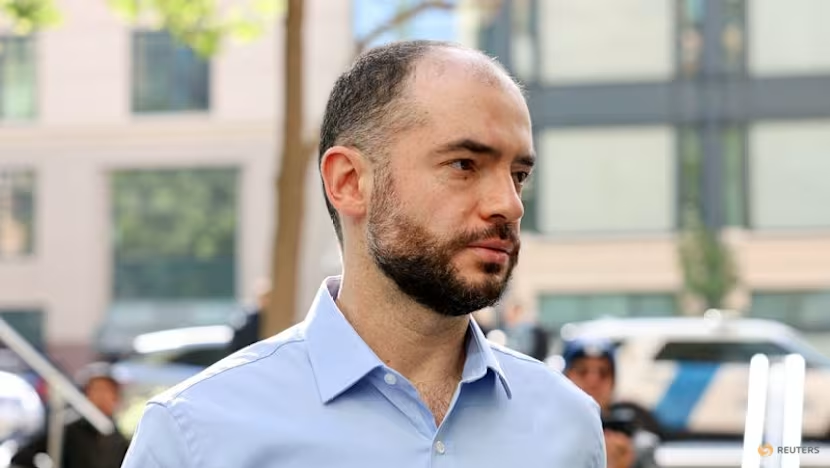
A US court has dismissed Elon Musk’s lawsuit against OpenAI and Sam Altman, ruling his breach-of-trust claims were filed too late.
In the high-stakes tech arena, the line between an altruistic crusade and corporate warfare can be thin. For over a year, a bitter, highly public legal war has pitted the world’s richest man against the poster child of the generative AI boom. On May 18, 2026, that battle came to a dramatic halt in an Oakland, California, federal courtroom.
As reported by TechCrunch, Elon Musk officially lost his sprawling lawsuit against OpenAI, its CEO Sam Altman, and its president Greg Brockman. A federal jury delivered a swift, unanimous advisory verdict rejecting Musk’s claims, which U.S. District Judge Yvonne Gonzalez Rogers immediately adopted to dismiss the case on the spot.
A Case Defeated by the Calendar
The decision did not ultimately center on the existential question of whether OpenAI violated its founding ethical mission. Instead, the multi-week trial, which laid bare the fractured, cringey corporate drama of OpenAI’s earliest days, crumbled on a fundamental legal technicality: timing.
The jury deliberated for less than two hours before concluding that Musk had missed the three-year statute of limitations required to bring his claims of breach of charitable trust and unjust enrichment. Musk, who co-founded OpenAI in 2015 and injected roughly $38 million into its early development, contended that Altman and Brockman “stole a charity” by shifting the lab away from its open-source, nonprofit origins into a commercially driven powerhouse.
However, OpenAI’s legal team presented substantial evidence proving that Musk was fully aware of the organization’s transitional plans to establish a capped-profit arm as early as 2017. As detailed by The Guardian, the defense argued that by waiting until 2024 to file suit, Musk’s complaints sat far outside the legal filing window. Judge Gonzalez Rogers reinforced this, stating there was “substantial evidence” to support the jury’s finding of an untimely filing. Microsoft, which was also named as a co-defendant due to its massive, multi-billion-dollar infrastructure partnership with OpenAI, was similarly cleared of any liability.
Corporate Sabotage vs. Broken Promises
Throughout the 11 days of intense testimony, the narrative vacillated wildly between high-minded debate over safe Artificial General Intelligence (AGI) and petty corporate jealousy.
As reported by Al Jazeera, Musk’s representation painted Sam Altman as an untrustworthy corporate manipulator who hijacked public-good technology for personal enrichment. Musk sought to force OpenAI and Microsoft to disgorge an estimated $134 billion back to the entity’s original charitable arm, while actively demanding Altman’s removal from the board.
Conversely, OpenAI’s counsel, William Savitt, successfully reframed the lawsuit not as a protective measure for humanity, but as a “hypocritical attempt to sabotage a competitor.” The defense highlighted that after a failed attempt to take over OpenAI in 2018, Musk walked away to build xAI, his own heavily commercialized, venture-backed AI competitor.
Clearing the Path to a $1 Trillion IPO
The timing of this dismissal is an extraordinary win for OpenAI. According to reporting by the LA Times, the firm has been aggressively restructuring its corporate architecture to transition entirely into a standard for-profit business. Stripping away the legal risk of Musk’s multi-billion-dollar claim directly paves the way for what could be one of the largest initial public offerings in financial history, with analysts estimating OpenAI’s current valuation to be hovering around $852 billion to $1 trillion.
While Musk took to X (formerly Twitter) to slam the verdict as a “destructive precedent for American charitable giving” and vowed to appeal, legal experts note he faces an incredibly steep uphill climb. For now, the structural foundation of the world’s leading AI lab remains intact, effectively validating that in Silicon Valley’s race to AGI, moving fast includes keeping a sharp eye on the legal clock.

About the Author
Jennifer Sakmufuwo Baba is a tech analyst, senior staff, and writer covering artificial intelligence, cybersecurity , and emerging technologies at TechRegard. Based in Nigeria, she's passionate about translating complex tech developments into compelling, accessible stories for diverse audiences. Her work focuses on how technology shapes innovation across Africa and globally.