

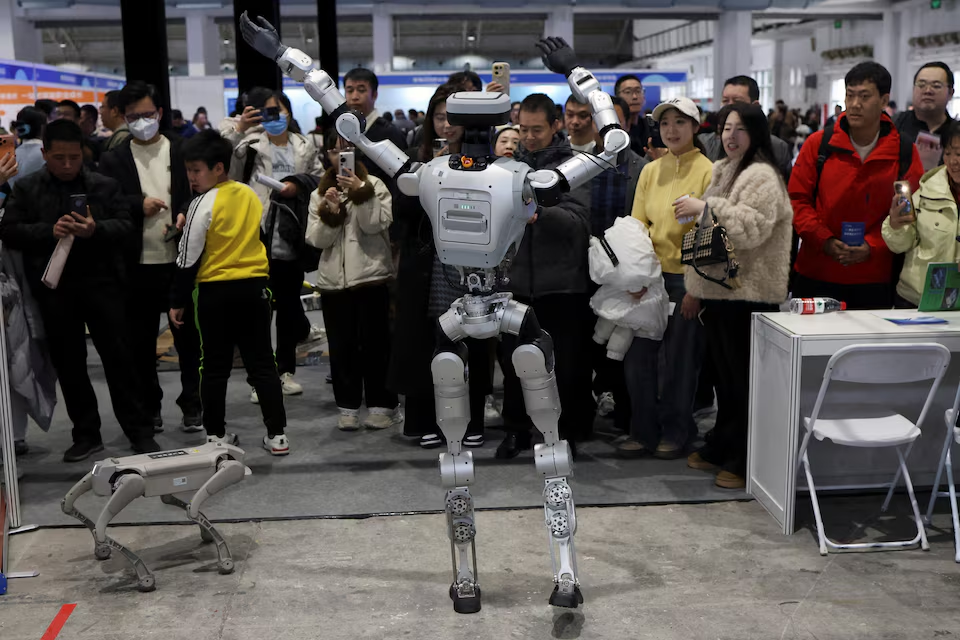
The US FCC is banning imports of foreign-made robots and power inverters to protect security and boost local manufacturing.
The United States government has taken a major step to restrict imports of foreign-made artificial intelligence robots and power equipment into the country. Federal Communications Commission Chairman Brendan Carr announced on Thursday, August 6, 2026, in Washington that new trade restrictions targeting foreign-built humanoid robots, four-legged robot dogs, and smart power inverters are designed to force companies to build these critical technologies on American soil. The regulatory chief emphasized that allowing millions of foreign-made smart machines into factories, power grids, and data centers poses serious national security risks that must be stopped immediately.
This sweeping trade move comes as the telecoms agency expands its efforts to secure America’s critical digital supply chains. Under the new directive, the agency has effectively blocked Chinese tech manufacturers from shipping new models of advanced humanoid robots and quadruped machines into the United States. The ban also covers connected power inverters, which are crucial electronic components that link solar panels, wind turbines, and large battery systems directly into municipal electricity grids and massive AI data centers.
To understand why American officials are putting strict locks on foreign robots, look at how modern machines operate behind the scenes. Today’s advanced robots are not just heavy metal toys; they are walking computers loaded with cameras, wireless sensors, microchips, and artificial intelligence software. If a foreign company builds these machines, security experts worry that hidden software backdoors could allow unauthorized users to spy on secure facilities, steal sensitive company data, or even shut down power systems remotely during a diplomatic crisis. By forcing tech investors to build robot factories locally, government leaders want to make sure every chip and sensor is fully secure.
The economic timing of these restrictions is critical because China currently dominates the global market for humanoid robotics, holding roughly eighty-five percent of worldwide production. Chinese manufacturers have been scaling up fast, offering high-tech automated workers at very low prices to international buyers. However, American regulators argue that relying heavily on foreign suppliers leaves the nation’s technological infrastructure vulnerable to sudden supply cutoffs or foreign government interference. Chairman Carr warned that the government refuses to wake up five years from now to find millions of foreign-controlled robots working across American factories and energy grids.
See Also: Levi Strauss Reports Cyber Attack After Hackers Trick Employees
This latest robot restriction has already sparked intense reactions across international markets. Government officials in Beijing immediately criticized the American move, calling it unfair market protectionism that hurts global trade. The trade row adds fresh tension between the world’s two largest economies ahead of planned diplomatic summits between top global leaders. Meanwhile, American tech firms and factory operators are scrambling to re-evaluate their supply lines, as switching to domestic robot suppliers will require heavy investments and new factory setups.
As artificial intelligence and automation continue reshaping modern business, the battle over who builds the world’s smart machines is getting tougher. The US government’s decision to shut out foreign-made robots shows that when it comes to high-tech machinery, national security and local production now come before low prices.

About the Author
Jennifer Sakmufuwo Baba is a tech analyst, senior staff, and writer covering artificial intelligence, cybersecurity , and emerging technologies at TechRegard. Based in Nigeria, she's passionate about translating complex tech developments into compelling, accessible stories for diverse audiences. Her work focuses on how technology shapes innovation across Africa and globally.


