German security agencies warn that Russian disinformation campaigns are spreading fake videos to target politicians ahead of state elections.
German security intelligence agencies have raised a serious alert, warning that Russian-backed online disinformation networks are heavily targeting the country to influence upcoming state elections. Security officials in Berlin revealed on Wednesday, August 5, 2026, that foreign influence operations have intensified significantly across major social media platforms. The primary goal of these coordinated digital campaigns is to create deep confusion among voters, ruin the reputations of top government leaders, and push political arguments across the European nation.
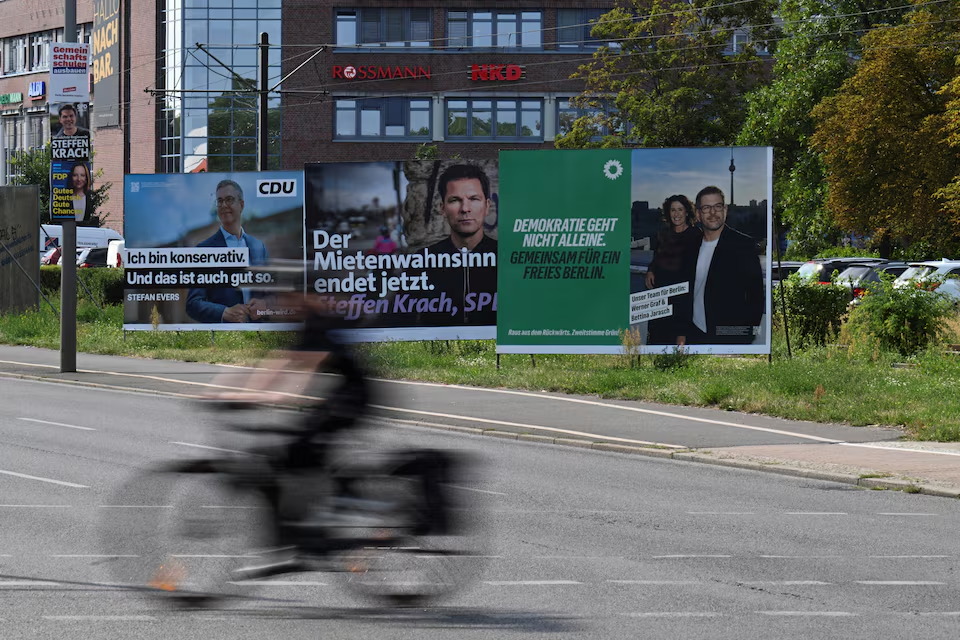
This security warning comes just weeks before citizens head to the polls in key German regions, including Berlin, Saxony-Anhalt, and Mecklenburg-Western Pomerania. Intelligence sources revealed that specialized tech companies operating under central direction inside Russia are managing these fake news operations. To make their propaganda look completely genuine, these online networks are creating short video clips stamped with official logos of trusted global news organizations like the BBC and German broadcaster ARD. These fake videos spread serious lies about ruling politicians, falsely accusing them of public fund theft, personal corruption, and official misconduct.
To understand why this digital election interference matters so much for the tech and political space, look at how modern online platforms carry real-world power during voting seasons. Security experts explain that foreign operatives do not need physical soldiers to destabilize a nation when they can simply use social media algorithms to spread false narratives to millions of smartphone users instantly. By constantly flooding internet feeds with engineered controversy, these campaigns aim to weaken public trust in democratic institutions, break down social unity, and make ordinary citizens doubt everything they read online.
The current disinformation wave specifically targets governing political groups, including the ruling Christian Democratic Union, the Social Democrats, the Greens, and the Free Democratic Party. Interestingly, security analysts noticed that these fake posts completely avoid attacking the far-right Alternative for Germany party or the left-populist Sahra Wagenknecht Alliance. Polls indicate that the Alternative for Germany party is currently performing strongly in eastern regions like Saxony-Anhalt, where it advocates for restoring ties with Moscow and ending economic sanctions linked to the war in Ukraine. By focusing attacks exclusively on traditional ruling parties, the foreign digital campaign seeks to tilt public sentiment toward pro-Russian political figures.
See Also: UK Warns Tech Giants to Fix AI Safety or Face Hard Laws
Cybersecurity researchers tracking the campaign report that operatives are using automated bot accounts across platforms like X, TikTok, and Bluesky to boost reach. Beyond false accusations against individual candidates, some fake posts fabricate survey results claiming that Germans are deeply unhappy with national unity. While intelligence agencies report that the actual voter engagement with these posts remains somewhat limited due to artificial boosting, the sheer volume of automated propaganda presents an ongoing threat to information integrity.
In response to these growing digital threats, German authorities and tech platforms are stepping up efforts to detect and take down fake media before the September voting dates arrive. Government officials emphasize that protecting public debate from artificial manipulation is essential for maintaining democratic integrity. As European nations face expanding hybrid threats in the digital age, Germany’s election security battle highlights how critical verifying online news has become for smartphone users everywhere.

About the Author
Jennifer Sakmufuwo Baba is a tech analyst, senior staff, and writer covering artificial intelligence, cybersecurity , and emerging technologies at TechRegard. Based in Nigeria, she's passionate about translating complex tech developments into compelling, accessible stories for diverse audiences. Her work focuses on how technology shapes innovation across Africa and globally.