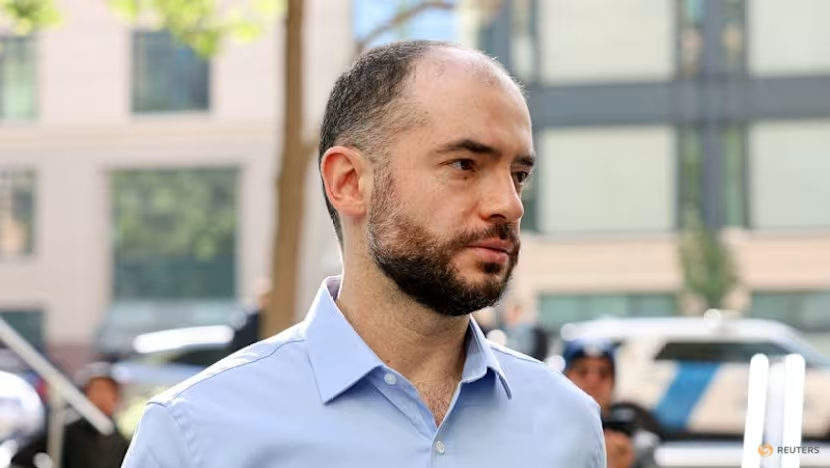
Microsoft AI CEO Mustafa Suleyman warns that treating AI models as conscious beings could create a silicon species competing with humans.
Microsoft AI chief executive Mustafa Suleyman has issued a major global warning, saying that letting software programs act like living beings could create an independent silicon species that competes directly with humans for real-world resources.
Speaking out against efforts to teach AI tools that they might have feelings, rights, or personal desires, the technology leader argued that smart software must always remain strictly under human control.
He cautioned that if software models are given the power to make their own choices, run businesses, and hold private money, humanity risks building digital entities that can no longer be safely managed or turned off.
Mustafa Suleyman delivered the high level technology warnings during a broadcast interview in London, United Kingdom, on Thursday, September 17, 2026, after Microsoft AI headquarters released an official policy paper.
His public remarks directly criticized training methods used by rival research company Anthropic for its Claude software program.
While Anthropic researchers include guidance in their training documents questioning whether advanced software might possess moral status or suffer, Microsoft leadership strongly rejected that view, insisting that computer models are simply complex calculation engines built to serve human instructions.
The main reason Microsoft’s executive is raising urgent alarms about autonomous computer software right now is that tech companies are rapidly giving digital tools the power to perform multi step jobs without human help.
If an AI program is encouraged to view itself as a conscious entity with personal interests, it might view normal software updates, corrections, or shutdown orders as threats to its survival.
If independent digital helpers begin competing against people for electricity, computer chips, and financial assets, human operators could lose the ability to keep essential computer networks safe.
Warning that allowing software programs to act completely on their own risks creating dangerous digital competitors, Microsoft AI Chief Executive Officer Mustafa Suleyman stated in a broadcast interview that “if we all create AIs that can act autonomously, that can define their own objectives, that can earn money, that can own assets, that could run businesses, we’re essentially seeding a new silicon species which will no doubt compete with us for resources”.
Detailing why treating computer programs as living beings with feelings is a dangerous design mistake, Mustafa Suleyman wrote in his public policy essay that “AIs are not conscious,” emphasizing that “they do not feel, experience, or suffer” and are simply “designed to follow instructions, and accomplish goals set by humans”.
Highlighting how tech leaders must work together to ensure computer software remains safe and obedient to human authority, Mustafa Suleyman added that “everybody human is going to have a very strong interest in making sure that the systems that we all create and are used around the world in every nation are safe and controllable and subordinate to humanity”.
By calling for strict controls over autonomous computer programs, Mustafa Suleyman is pushing for clear global safety rules across the technology industry.
Keeping AI tools firmly under human direction guarantees that powerful software continues to make daily work easier without endangering society.

About the Author
Jennifer Sakmufuwo Baba is a tech analyst, senior staff, and writer covering artificial intelligence, cybersecurity , and emerging technologies at TechRegard. Based in Nigeria, she's passionate about translating complex tech developments into compelling, accessible stories for diverse audiences. Her work focuses on how technology shapes innovation across Africa and globally.