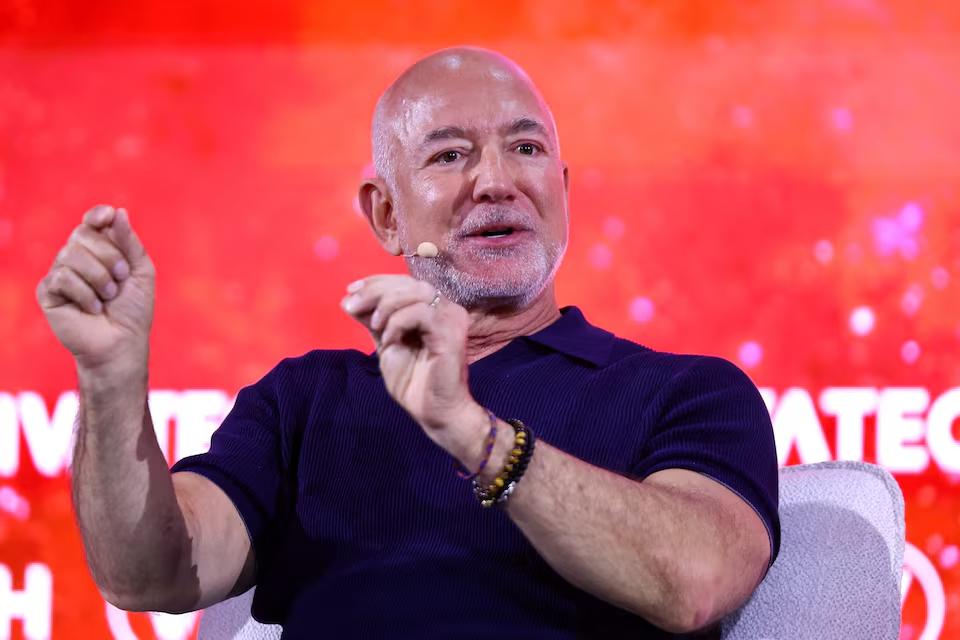
Amazon founder Jeff Bezos predicts AI will create a labor shortage by supercharging productivity rather than making human workers obsolete.
While global labor unions, policymakers, and anxious tech professionals brace for potential mass unemployment driven by automation, one of the world’s prominent technology architects is predicting the exact opposite outcome. Speaking on stage at Europe’s premier startup and innovation exhibition, VivaTech 2026 in Paris, Amazon founder and billionaire entrepreneur Jeff Bezos pushed back against the prevailing narrative that artificial intelligence will make human workers redundant. Instead, Bezos argued that advanced automation will supercharge productivity so sharply that it will ultimately trigger an acute labor shortage.
“I know there’s a lot of concern that many people have, including many smart people, that AI is going to make humans redundant and so on,” Bezos stated during his keynote interview. “I totally disagree with this point of view. And I think, in fact, AI is going to create a labor shortage.”
The Economic Theory of Unbounded Demand
Bezos’s counterintuitive thesis relies on a fundamental economic concept: human ambition and our list of tasks are functionally endless. In his view, society is currently constrained not by a lack of ideas or projects, but by structural barriers to execution. By lowering these barriers and handling repetitive, time-consuming tasks, AI serves as an operational leverage point.
According to an analysis of his speech by the Washington Examiner, Bezos believes that the resulting productivity spike will elevate household wealth so effectively that it could allow individuals in two-earner households to voluntarily exit the workforce while maintaining their standard of living, thereby shrinking the overall labor supply.
The Friction on the Ground
However, Bezos’s macro-level optimism stands in contrast to the disruption currently rippling through corporate back offices. According to a workforce report by Allwork. Space, U.S. employers announced over 97,000 job cuts in May alone, with outplacement data linking roughly 40% of those corporate layoffs directly to realigned AI efficiencies.
Even Amazon has scaled back, trimming nearly 30,000 corporate and technical roles since late last year. Current Amazon CEO Andy Jassy has publicly noted that deep algorithmic integration will inevitably result in specific corporate job losses as teams restructure. Furthermore, recent consumer sentiment polling indicates that half of the public fears AI integration could displace someone in their household, forcing lawmakers like Senator Elizabeth Warren to lobby for safety nets to protect workers during this transitional phase.
From Digital Code to Orbital Manufacturing
For Bezos, the transition to automated artificial engineering is structurally linked to an even larger goal: moving heavy, polluting industrial manufacturing off the Earth entirely. Appearing alongside Blue Origin CEO David Limp, Bezos framed AI optimization as a necessary prerequisite to managing complex cosmic engineering.
While the near-term transition will require navigating tricky corporate restructuring and labor friction, Bezos insists that the long-term destination of the AI era isn’t a jobless society; it’s an era where human labor is the rarest resource on Earth.

About the Author
Jennifer Sakmufuwo Baba is a tech analyst, senior staff, and writer covering artificial intelligence, cybersecurity , and emerging technologies at TechRegard. Based in Nigeria, she's passionate about translating complex tech developments into compelling, accessible stories for diverse audiences. Her work focuses on how technology shapes innovation across Africa and globally.