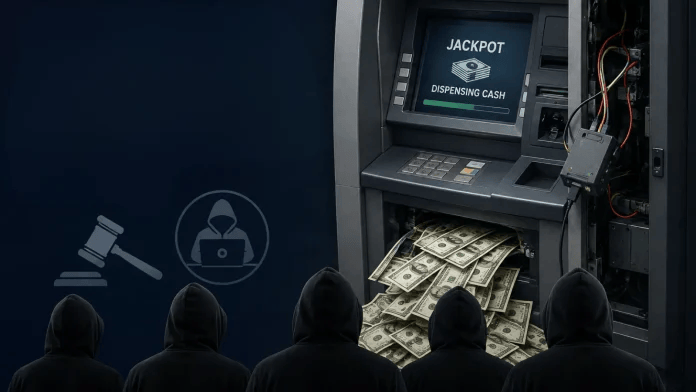
Five hackers plead guilty in US court after using malicious software to force bank cash machines to spit out money.
Five men have admitted guilt in a United States federal court after attempting to force automated teller machines to spit out huge piles of cash using malicious computer software.
The illegal technique, known as ATM jackpotting, involves physically opening a cash machine cabinet and connecting specialized computer programs to force the internal machinery to dispense stored bills continuously without requiring a valid bank card, PIN code, or account balance check.
While the group targeted multiple cash locations across midwestern towns, automatic security alarms and video cameras caught the suspects before they could escape with stolen funds.
The formal court guilty pleas were officially recorded in federal updates on Tuesday, September 1, 2026, following a thorough investigation led by the Federal Bureau of Investigation.
Legal filings confirm that five Venezuelan nationals, Luis Alberto Velasquez Artigas, Royder Adrian Figuera Perez, Javier Mejia Jr., Gabriel Alexandro Corales Garcia, and Italo Lizandro Corrales Carrillo, each pleaded guilty to conspiracy to commit bank larceny.
The failed attacks took place across bank sites in Wamego and Manhattan, Kansas, after the group traveled from Indiana to carry out the thefts.
Court documents show that Luis Alberto Velasquez Artigas has already been sentenced to nine months in prison, while his four co defendants await formal sentencing.
The main reason these physical hacking attacks are becoming popular among organized criminal groups is that bad actors are actively looking for older cash machine models that lack strong hardware locks or modern software protections.
Instead of stealing individual customer credit card details, thieves open the machine casing and connect a laptop or specialized flash drive pre loaded with bad software.
See Also: Japan Launches New Dedicated Cyber Security Division to Fight AI Driven Cyberattacks
Once the virus gains control over the internal cash cassette, remote commands trigger the machine to spit out all its paper money like a winning casino slot machine.
However, modern bank security updates, loud physical door alarms, and real time surveillance cameras helped law enforcement interrupt the gang before they could clear out the cash.
On how bad actors selectively target specific cash machines across the country, U.S. Attorney Ryan A. Kriegshauser stated that “jackpotting bandits are sweeping the nation. This particular group’s strategy was to specifically target ATMs they thought were by design more vulnerable to malware”.
Urging financial institutions to upgrade physical locks and install stronger software tools to block bad programs, U.S. Attorney Ryan A. Kriegshauser added that “fortunately, there is technology to help thwart jackpotting”.
Highlighting how federal law enforcement agencies track down physical bank hackers, FBI Kansas City Special Agent Chris Ormerod noted that “in these attacks, criminal actors exploit vulnerabilities in ATM technology to access and steal the cash contained inside the machines, often without legitimate transactions ever taking place”.
By catching physical cash machine hackers and securing guilty pleas in court, law enforcement teams are sending a strong message to bank thieves.
Updating computer security on cash dispensers and keeping camera networks active ensures that neighborhood bank machines stay safe and reliable for everyday citizens.

About the Author
Jennifer Sakmufuwo Baba is a tech analyst, senior staff, and writer covering artificial intelligence, cybersecurity , and emerging technologies at TechRegard. Based in Nigeria, she's passionate about translating complex tech developments into compelling, accessible stories for diverse audiences. Her work focuses on how technology shapes innovation across Africa and globally.