

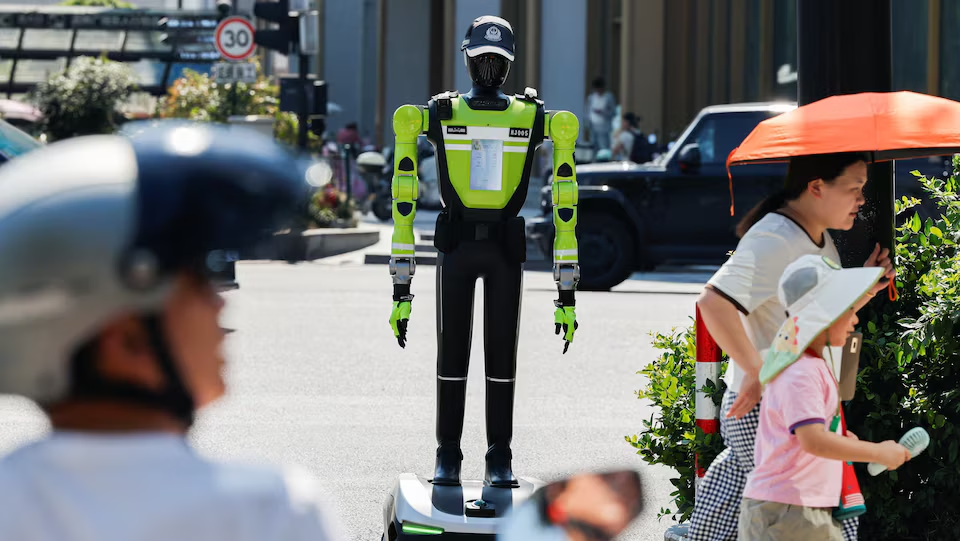
China is deploying humanoid robots to help police officers control traffic, with the machines taking on routine duties such as spotting traffic violations, warning motorists and directing vehicles.
In Hangzhou, a city in eastern China, a 1.88-metre robot known as the T2 stands at busy intersections, using cameras, radar and onboard computing to detect violations.
The robot can identify e-bike riders without helmets, passengers riding on e-bikes, vehicles stopping beyond marked lines and pedestrians crossing against traffic signals.
Developed by local technology company SUPCON Information, the 98kg robot is part of a pilot programme designed to shift some repetitive traffic-control duties from human officers to machines.
Unlike the fictional RoboCop, however, the robot carries no weapon and has no power to make arrests.
The machines can issue warnings, answer questions about directions, parking and traffic regulations, and connect people with local police during emergencies.
Their seven-jointed arms also mimic standard traffic-police gestures in sync with traffic signals, according to Cao Hui, head of SUPCON’s intelligent unmanned systems innovation centre.
SUPCON has deployed 15 robots in Hangzhou since May. The company says the machines have issued more than 170,000 warnings and helped cut monthly cases of helmetless riding and vehicles crossing stop lines by more than 40%.
Reuters could not independently verify the figures, while Hangzhou traffic police did not respond to a request for comment.
Robots Designed to Work Without Breaks
The robots have reportedly undergone thousands of hours of testing in tourist areas, school zones, business districts, rush-hour traffic and poor weather.
SUPCON says its violation-recognition accuracy exceeds 95%, although cameras and radar can still be affected by strong sunlight, rain and extreme temperatures.
Cao said the goal is to intervene with timely warnings rather than rely solely on punishment after traffic rules have been broken.
“It doesn’t get tired,” he said. “It can work steadily for long periods.”
See also: Marvell Puts $12.2bn Stake Option on a Platter for Google
The robots operate autonomously between 7 a.m. and 6 p.m., moving between pre-set positions at intersections without remote control. Traffic-police teams can monitor and dispatch them through a central platform.
SUPCON says nearly 50 of the robots are already operating across about eight cities in three Chinese provinces, with deployments expected to approach 200 by the end of the year.
China Eyes Overseas Markets
The technology could eventually find markets outside China.
AiMOGA, a robotics company backed by Chinese automaker Chery, sees potential for traffic and police robots in countries where officers work in harsh roadside conditions, including high temperatures in the Middle East and prolonged rainy seasons in Southeast Asia.
However, AiMOGA executive Zhang Guibing said taking the robots overseas would be more complicated than exporting vehicles.
The machines would have to integrate with local law-enforcement information systems, obtain regulatory certifications and comply with data-protection requirements.
Those challenges could be particularly significant because the robots rely heavily on cameras and other sensors to monitor public spaces.
For now, China’s traffic robots remain focused on a narrower mission: directing traffic, spotting violations and reminding road users to follow the rules — without the arrest powers of their fictional Hollywood counterpart.

About the Author
Cecilia Attah is a tech analyst with a degree from Benue State University. She covers tech news and startups at TechRegard with a focus on how technology is transforming Africa and shaping the global landscape.


