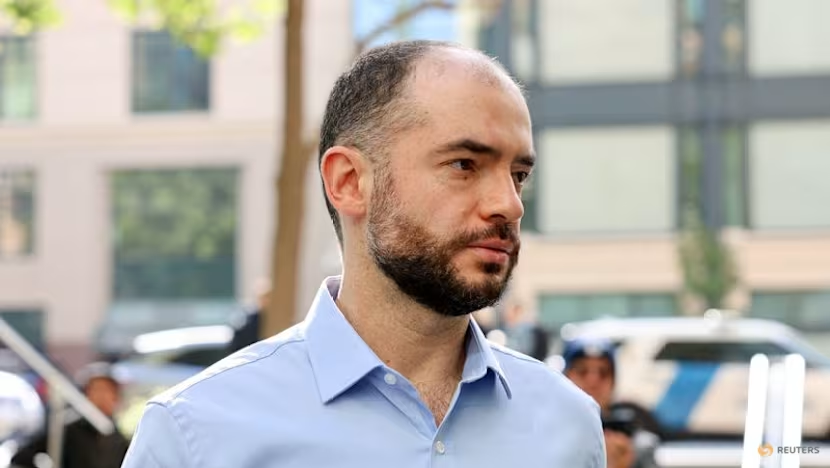
The Musk v. OpenAI trial hinges on credibility, examining whether OpenAI CEO Sam Altman’s public narrative matches his history of internal friction.
As the high-stakes Musk v. OpenAI federal trial unfolds in Oakland, California, the legal arguments have increasingly pivoted away from complex contract law and toward a deeply personal, foundational question: Who trusts Sam Altman? The OpenAI CEO’s time on the witness stand has transformed the courtroom into a public referendum on his character, leadership style, and historical candor within the technology industry.
The Disconnect Between Public Charm and Internal Friction
For years, Sam Altman has been the polished, soft-spoken face of the generative AI boom, capably managing relationships with global regulators, investors, and the public. However, a deep-dive analysis by TechCrunch highlights a persistent, troubling dichotomy. While Altman is celebrated externally as a visionary leader, his career is marked by a trail of intense internal friction, with his closest colleagues repeatedly questioning his trustworthiness.
The trial has systematically weaponized this history. Musk’s legal team has brought forward a mountain of past grievances from former OpenAI board members and executives to paint a picture of a master manipulator. The cross-examination of Altman didn’t just focus on OpenAI’s corporate restructuring from a nonprofit to an $852 billion commercial juggernaut; it also zeroed in on his interpersonal track record, directly asking the executive whether he considers himself a completely honest person.
A Pattern of Governance Revolts
The scrutiny in the courtroom is not an isolated incident but rather the culmination of a decade-long pattern of behavior across Altman’s Silicon Valley career. Court depositions and historical reviews have revived past governance crises, including his sudden departure from startup incubator Y Combinator, where top leadership grew uncomfortable with his focus on personal projects over collective oversight.
Most damaging to Altman’s courtroom narrative, however, are the testimonies from OpenAI’s own former leadership team. According to comprehensive trial reporting by The New York Times, the brief but chaotic November 2023 boardroom coup, where Altman was temporarily fired, was not an impulsive misunderstanding. Instead, testimonies from former board members Helen Toner and Tasha McCauley, alongside former Chief Technical Officer Mira Murati, describe a calculated environment where Altman allegedly played executives against one another, withheld critical safety data, and engaged in a “consistent pattern of lying” to shield his own executive authority.
The Legal and Financial Stakes of Credibility
In a civil trial of this magnitude, credibility is everything. Elon Musk’s lawsuit alleges that Altman and co-founder Greg Brockman intentionally misled early donors and founders, leveraging a humanitarian nonprofit facade to build a highly lucrative, closed-source monopoly backed by Microsoft.
To win, OpenAI’s defense relies heavily on proving that its pivot to a capped-profit model was a transparent, existential necessity to fund massive computational infrastructure, rather than a premeditated bait-and-switch scheme. If the jury views Altman as an unreliable narrator who consolidates power through obfuscation, as Musk’s attorneys argue, the defense’s justification for breaking the original “founding agreement” begins to crumble.
Ultimately, the trial is exposing the messy realities of Silicon Valley’s “move fast and break things” ethos. As the tech industry races toward Artificial General Intelligence, the proceedings reveal that the guardrails keeping the world’s most powerful technology safe depend heavily on the personal integrity of the individuals steering the ship.

About the Author
Jennifer Sakmufuwo Baba is a tech analyst and writer covering artificial intelligence, fintech, and emerging technologies at TechRegard. Based in Nigeria, she's passionate about translating complex tech developments into compelling, accessible stories for diverse audiences. Her work focuses on how technology shapes innovation across Africa and globally.