

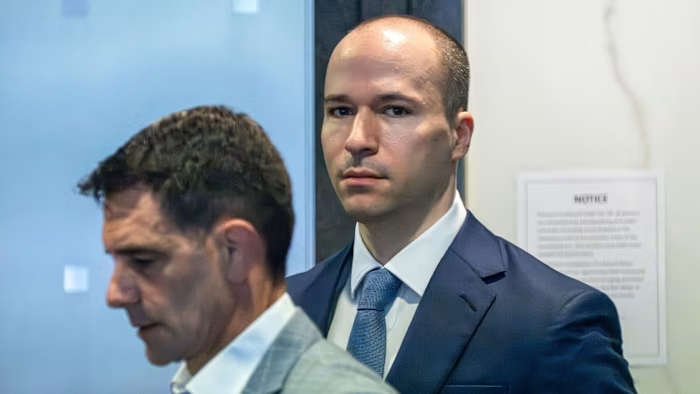
Greg Brockman testifies that Elon Musk’s exit from OpenAI followed a tense 2017 meeting where Musk’s demand for absolute control was rejected.
The high-stakes legal battle between Elon Musk and OpenAI reached a fever pitch this week as OpenAI President Greg Brockman took the stand in an Oakland federal court. His testimony provided a cinematic, play-by-play account of the 2017 meeting that effectively ended Musk’s tenure at the company he helped found, painting a picture of a partnership that didn’t just dissolve, it imploded.
The Meeting That Changed Everything
In late August 2017, OpenAI’s founding team gathered to discuss a pivotal transition. The success of their AI in defeating top human players in the video game DOTA II had signaled a new era: to achieve Artificial General Intelligence (AGI), they needed massive amounts of “compute,” which required capital far beyond what a non-profit could attract.
According to Brockman’s testimony, Musk arrived at the meeting with an ultimatum. He demanded “unequivocal” and absolute control over the proposed for-profit entity. When Brockman, Sam Altman, and Ilya Sutskever refused to grant him total power, the room fell into a heavy, minutes-long silence.
“I decline,” Musk reportedly said, before standing up and storming around the conference table. Brockman testified that the tension was so palpable he feared Musk might “physically attack” him. In a final, symbolic gesture of the bridge being burned, Musk reportedly grabbed a painting of a Tesla, a gift Sutskever had commissioned for him, and walked out, asking Brockman, “When will you be departing OpenAI?”
The Journal Entries: Greed or Governance?
Musk’s legal team, led by attorney Steven Molo, attempted to flip the narrative by leaning on Brockman’s own personal journals. One November 2017 entry proved particularly contentious: “It’d be wrong to steal the non-profit from him… that’d be pretty morally bankrupt.”
Musk’s lawyers argued this was an admission of a plot to push Musk out while keeping the company’s assets. Brockman countered that the entry reflected his internal struggle over whether to remove Musk from the board for the sake of the company’s survival. He emphasized that the co-founders ultimately waited for Musk to resign voluntarily in February 2018 rather than “stealing” anything.
A Battle of Billion-Dollar Stakes
The cross-examination also targeted Brockman’s current wealth, which is estimated at $30 billion following OpenAI’s recent $150 billion valuation. Lawyers questioned why Brockman hadn’t donated his massive stake to charity if the original mission was purely philanthropic.
Brockman’s response was pointed: he argued that the value was built through “hard work, blood, sweat, and tears” in the years after Musk left, having predicted the company would fail. He further dismissed Musk’s technical contributions, stating that while Musk knows “rockets and electric cars,” he “does not know AI.”
Broader Implications
This trial, as reported by The Guardian and TechCrunch, is more than a personal spat; it is a landmark case for Silicon Valley. It explores the legal boundaries of transitioning non-profit research into for-profit commercial powerhouses and may set a precedent for how future AGI ventures are governed.
https://www.youtube.com/watch?v=Do0j12fG0Rw
This video provides a concise news report on the specific moment in Brockman’s testimony where he described his fear of a physical confrontation with Musk.


